
A maximal effort on a rowing machine requires the balancing of effort per stroke and stroke frequency. A stroke rate that is too low will drastically increase the force generation and muscle contraction requirement to hold a given power, greatly increasing the muscular fatigue during an effort. Conversely, as stroke rate increases, the demand for energy spent during the recovery on moving the mass of the rower forward to take another stroke increases exponentially. The balance of these two things results in most athletes settling on stroke rates that suit their anatomy and physiology and match the duration of effort they are attempting, a skill that is learned through feeling and lots of practice.
What I aim to do here is investigate the second of these two limitations – the energy spent on the recovery as a result of the stroke rate. There have been previous descriptions of this energy/power using theoretical approaches. I believe these approaches significantly underestimate the power requires on the recovery, and while they acknowledge this, I believe the scale of the underestimation is larger than most would think. Using a simulation of a number of individuals on a rowing machine, I will calculate this “recovery power” and compare it against the theoretical methods.
Method
The Physics of Rowing website does a good job of explaining the mechanics behind the power requirement to move the athlete’s body, and the effect between different factors (stroke-rate, stroke-length, mass etc.). However, it relies on a large number of assumptions that limit the accuracy of the derived formula. An adaption of their formula that takes into account the drive-recovery ratio – derived here – is:
$$P= m \left(\frac{s}{1-f} \right)^2 \left(\frac{R}{60}\right)^3$$
Where is $m$ the rower’s mass, $s$ is the distance that the rower moves, $R$ is the stroke rate in strokes/min and $f$ is the proportion of the duration of a stroke spent on the drive.
Even with this refinement, the formula still relies on an accurate estimation of the distance that the rower’s centre of mass moves and assumes a constant velocity on the recovery, which will lead to significant inaccuracies vs. the actual value due to the cubic velocity term.
Using a kinematic model, the recovery power can be far more accurately calculated for a given individual by observing the instantaneous acceleration of their body’s centre of gravity and inferring the work that must have been done to illicit the movement using Newton’s 2nd Law and the power equation:
$$F=m\frac{d^2x}{dt^2} \qquad \qquad P=F\frac{dx}{dt}$$
The average power to move the body-mass through the rowing stroke can then be calculated from the instantaneous observations from the simulation.
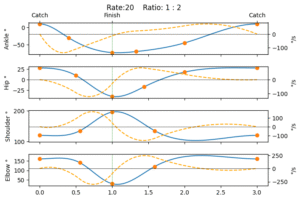
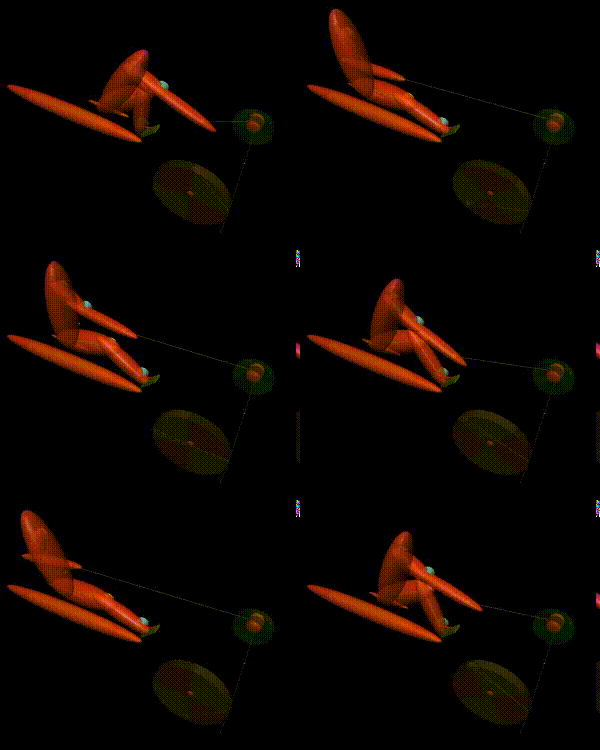
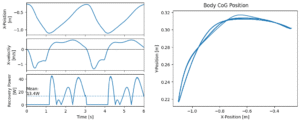
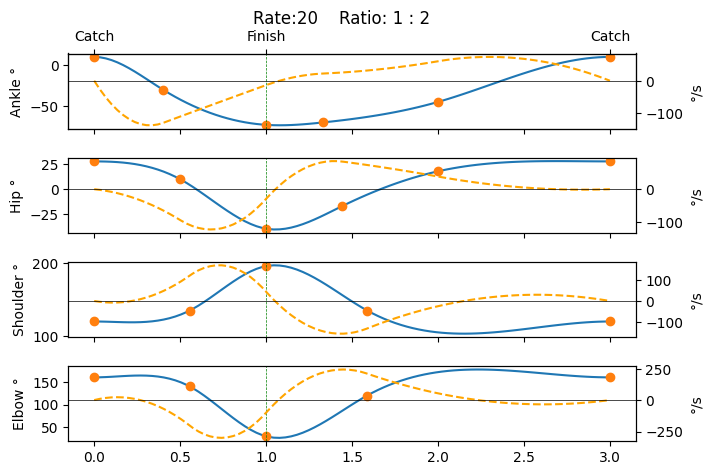
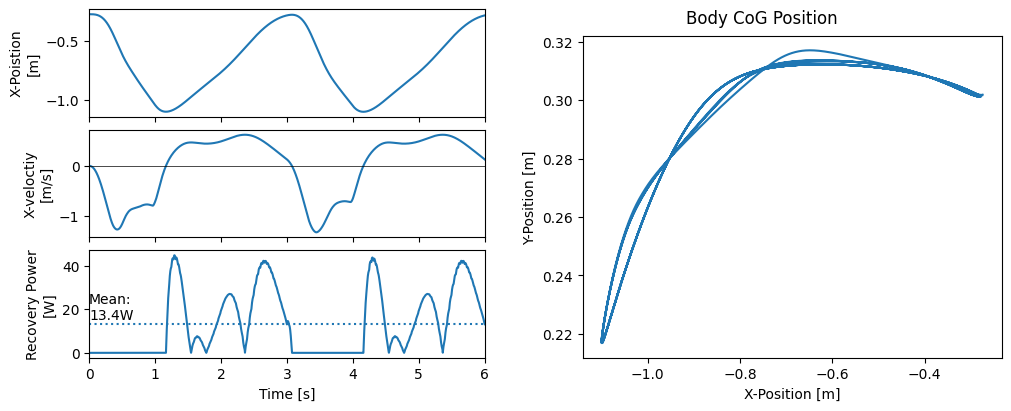
The simulation was run using models of 4 different individuals, with the across a variety of target joint angle and velocity profiles set to scale the drive:recovery ratio from 1:2 to 1:1. The power required each individual to perform the recovery motion calculated alongside the theoretical value as determined by the above formula. The theoretical value was calculated with $s$ as the horizontal distance travelled by the athlete’s Centre of Mass in the simulation.
Results are presented below, for the 4 different individuals, selectable from the drop down by weight and height, and 7 stroke ratios.
Analysis
These results clearly follow the same profile as the theoretical results and the relationship between results appears relatively consistent between individuals, indicating that the relationships between weight, speed and stroke length are properly represented in the simulation. The recovery power measured in the simulation is significantly (~2.5x) higher than that in that in the calculation as a result of the centre of mass moving with a non-constant velocity.
The values measured in simulation for the “recovery power” are significant in comparison to the power output measured by the erg, especially at higher rates. As an example, the athlete which the 100kg – 1.96m model is based on performs a 2km test in 6:16, equivalent to 435W at a rate of 30strokes/min, and a stroke ratio of 0.5. The simulation shows that the erg-measured wattage is “missing” 15% of the power produced by the athlete. This “missing” power is likely a significant contributor to the discrepancy in muscular efficiency observed between rowing and more continuous/steady movements like cycling and running.
Conclusion
It is a necessity when using a rowing machine that some portion of total energy expenditure is spent on moving the mass of of the athlete’s body mass. This energy/power increases at an exponential rate as stroke rate and stroke ratio increase. Overall performance, as measured by the erg, is maximised by balancing the potential for increased muscular fatigue with a lower stroke rate against the extra energy expenditure of a higher rate.
While this investigation likely will not change the way that the majority of athletes will approach maximal tests, hopefully it provides an explanation for why increasing stroke rate becomes harder the higher it already is. Additionally this shows where the compromise between stroke rate, length and peak force comes from, and that the optimisation of this compromise is highly dependent on an individual’s weight, size and proportions and strenght.
The next investigation using this modelling technique will look at the difference in muscular force development requirements and skeletal loading when an athlete is asked to hold a set of different rates at a given target split/power output.