
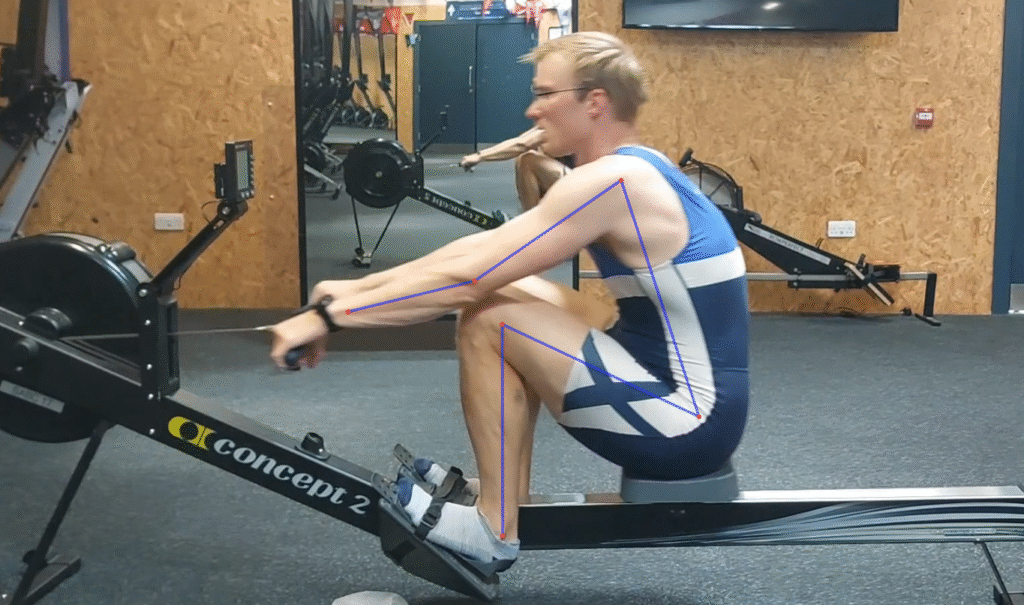
Most coaches will observe athletes performing slightly different motions on a rowing machine when operating at different effort levels – generally with the separation of the movement of arms, body and legs deteriorating as effort levels and stroke-rates increase. SyncRow offers coaches and athletes the ability to quantify these differences and highlight areas of athlete’s technique that require focus or refinement at particular effort levels.
Here we have an example of the average stroke profiles determined by SyncRow for a single athlete using a Concept2 RowErg at a variety of known test paces; UT2/Steady State, 30min R20, 5km and 2km. The start and finish point of each stroke is the “catch”, which is detected as the point where the knee angle is at its minimum.
Scaling for both Time/X-Axis and Value/Y-Axis can be selected below the plot. If you want to isolate a particular joint angle or recording click on the legend. Selection can be reset by double clicking elsewhere on the plot.
Time/X-Axis Options
Value/Y-Axis Options
Analysis
There are a number of insights that can be drawn from this data drawn for this athlete. We can go through the different scaling options to inspect different aspects of the differences between stroke profiles.
- Real Time – The stroke-rates in strokes/min for each of the profiles can be determined by dividing 60 by the duration of the profile. The 2km profile having been done around 28strokes/min and the UT2 and 30minR20 at 20strokes/min.
- Normalise Time – The difference in stroke ratios becomes clear – looking at the point at which the elbow joint velocity crosses the 0 line would generally be the indicant of the finish position – with the two 20 stroke/min profiles having 1:2 and the 2km close to 1:1.
- Equalise Drive and Recovery – Using this scaling, a number of differences and technical flaws can be observed:
- Looking at the peaks and overall shape of the velocity profiles, one can see that this particular athlete has a couple issues with sequencing that a number of coaches would want to correct. They are consistently beginning to “open” their back at the same time as they start moving their legs at the start of the drive. This improves at higher rates and effort levels but is a result of their legs moving faster rather than their bodies being held in position.
- They are also moving their hands and bodies together at the start of the recovery, particularly at the higher rates, whereas most coaches would likely want to see a higher degree of separation between the movement of arms and bodies.
- As the effort level and stroke rate increases, there is a significant increase in the knee joint speed right at and even starting before the finish. This is a result of the athlete effectively “pulling themselves up the slide” from the finish, which will have an effect on the overall length of their stroke.
- It is clear that a significant proportion of the increase in power between UT2 and 30r20 profiles comes from increased drive length as a result of the athlete leaning ~5$^\circ$ further back, and closing their elbow by a couple more degrees. A significant number of coaches would probably want to see the increase in power coming from a increase in leg speed earlier in the drive phase rather than later when the body is moving.